
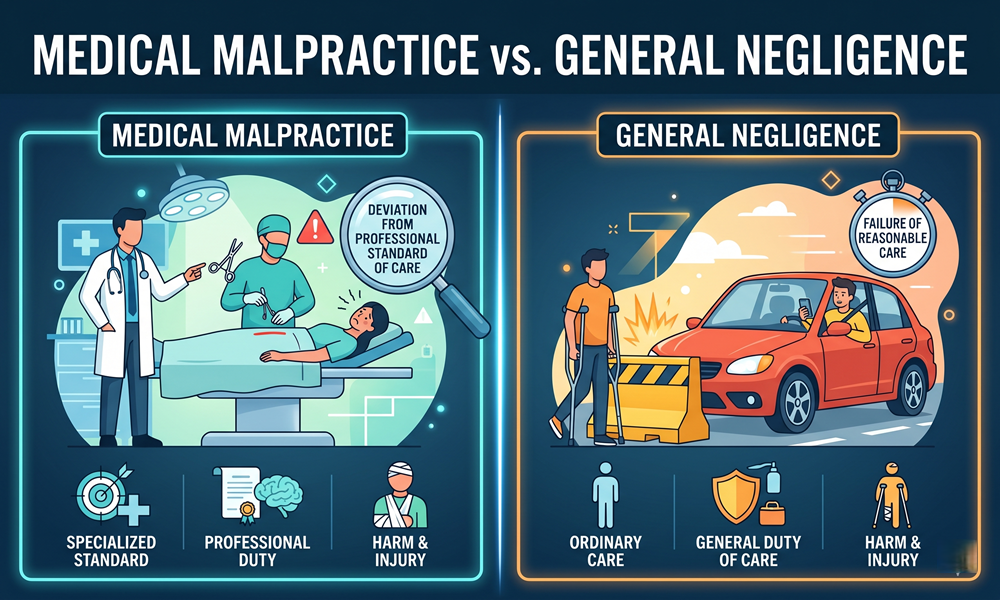
Medical Malpractice vs. Negligence: Understanding the Legal Difference
When a patient is harmed during medical treatment, the questions that follow are often framed in general terms: was the doctor negligent? Was it malpractice? In everyday conversation these words are used interchangeably, but in law they describe related yet distinct concepts with different legal standards, different procedural requirements, and different implications for how a claim is built and pursued.
Understanding the difference is not just academic. It determines what type of case you have, what evidence is needed to support it, and which legal pathway is appropriate for your situation.
What Negligence Means in a Legal Context
Negligence is a broad legal concept that forms the foundation of most personal injury law. In its simplest form, negligence occurs when a person or entity fails to exercise the standard of care that a reasonably prudent person would exercise in the same circumstances, and that failure causes harm to another person. Four elements must be established to prove negligence: a duty of care existed, that duty was breached, the breach caused the plaintiff’s injury, and the injury resulted in quantifiable damages.
Negligence can be committed by anyone in almost any context. A driver who runs a red light and causes a collision is negligent. A property owner who fails to clear ice from a footpath and causes a visitor to fall is negligent. A business that fails to maintain safe equipment that injures an employee is negligent. The standard is based on what a reasonable person in the same situation would have done.
What Makes Medical Malpractice Different
Medical malpractice is a specific category of negligence that applies when a healthcare professional, such as a physician, surgeon, nurse, anaesthesiologist, or hospital, fails to meet the accepted standard of care within their profession and that failure causes patient harm. The key distinction is that the standard is not what a reasonable layperson would do, but what a reasonably competent medical professional in the same specialty and with the same training would do under the same circumstances. Experienced Chicago injury lawyers who handle medical malpractice cases work with qualified medical experts who can establish what that professional standard required and demonstrate precisely how it was breached.
This professional standard requirement makes medical malpractice cases considerably more complex than general negligence claims. Establishing that a doctor’s decision fell below the standard of care in their specialty requires expert testimony from a qualified professional in the same field. In Illinois, an attorney filing a medical malpractice case must attach an affidavit from a healthcare professional confirming that the claim has merit before the case can proceed. This requirement exists to discourage unfounded claims and reflects the technical complexity of evaluating medical decisions.
The Four Elements Applied to Medical Malpractice
The same four elements of negligence apply to medical malpractice, but their application is specific to the healthcare context. The duty of care is established by the doctor-patient relationship. Once a physician agrees to treat a patient, a duty of care exists. The breach element requires showing that the treatment provided, or the failure to provide appropriate treatment, fell below the accepted standard for that specialty. Causation requires demonstrating that the breach, not the underlying illness or injury, was the direct cause of the patient’s harm. And damages must be established in concrete terms, including physical harm, additional medical costs, lost earnings, and pain and suffering.
Causation is frequently the most contested element in medical malpractice cases. Patients who are already ill or injured present complex factual situations where defence attorneys will argue that the adverse outcome resulted from the underlying condition rather than from any error by the treating physician. Establishing that the negligent act, and not the pre-existing condition, caused the additional harm requires detailed medical evidence and credible expert analysis.
Common Examples That Illustrate the Distinction
A driver who rear-ends your vehicle because they were distracted by their phone is negligent under the standard personal injury framework. The standard is what a reasonable driver should do, the breach is clear, and causation is straightforward.
A surgeon who operates on the wrong spinal level because they failed to review the imaging correctly is committing medical malpractice. The standard is what a reasonably competent spinal surgeon would do before proceeding with an operation. The breach is the failure to follow that standard. The causation connects that failure to the patient’s subsequent harm. The same framework applies, but the professional standard and the complexity of establishing causation place it firmly in the medical malpractice category.
A hospital that fails to maintain sterile conditions in an operating theatre and a patient develops a serious post-operative infection may be pursuing a claim that involves elements of both general negligence, the facility’s operational failure, and medical malpractice, the clinical standard of infection prevention. These situations often require analysis of both frameworks to determine the most effective legal strategy.
Why the Distinction Matters for Your Case
Medical malpractice claims in Illinois have specific procedural requirements, expert witness obligations, and in some contexts different damages caps that do not apply to general personal injury cases. Filing under the wrong framework, or failing to meet the procedural requirements specific to malpractice, can result in a case being dismissed that would otherwise have merit.
The distinction also affects how quickly you need to act. While both claim types have deadlines under Illinois law, the discovery rule in medical malpractice cases and the specific filing requirements mean that getting legal advice promptly after a suspected medical error is particularly important.
If you or a family member has been harmed during medical treatment and you are trying to understand whether you have a viable claim, speaking with a Chicago medical malpractice attorney is the most reliable way to get an accurate assessment. The legal and medical complexity of these cases means that early, expert guidance is not just helpful, it is the foundation on which any successful claim is built.