How Elite Legal Teams Prepare for Outcomes They Can’t Fully Control
Control is limited in a courtroom. Facts matter. Law matters. Preparation matters. The outcome still depends on people. Jurors interpret. Judges rule. Opposing counsel reacts. That mix creates uncertainty.
Elite legal teams accept that early. They do not chase control. They build systems to operate without it.
A trial can run for weeks. It involves thousands of documents, dozens of witnesses, and shifting arguments. Even with strong preparation, no team can predict how every moment will land.
One trial lawyer described a case where a key witness gave an unexpected answer under cross-examination. “We had prepared for every version we could think of,” he said. “That answer wasn’t one of them. What saved us was not the script. It was the structure we had built around the case.”
That structure becomes the foundation when control breaks down.
Preparation Focuses on What Stays Stable
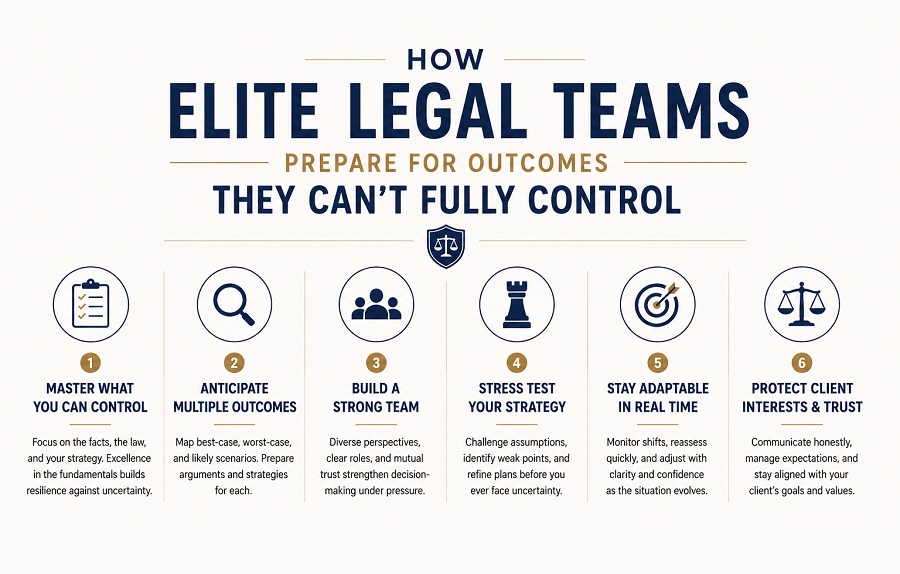
Elite teams separate what they can control from what they cannot.
They cannot control how a juror feels about a witness. They cannot control how opposing counsel frames a point. They cannot control timing shifts during trial.
They can control how the case is built.
That means defining a small set of core ideas that do not change. These ideas guide every decision.
In one patent case, a team reduced the entire dispute to three questions. Every witness, exhibit, and argument connected back to those questions.
“When something unexpected happened, we didn’t panic,” the lawyer said. “We asked one thing. Does this change our three questions? If not, we stayed on track.”
This approach reduces noise. It creates a stable path through unpredictable moments.
Repetition Builds Reliability
Trials involve repetition. Not because teams lack creativity, but because consistency builds understanding.
Research on learning shows that repetition improves retention. People need to hear the same idea multiple times in different forms before it sticks.
Elite teams design for that.
They repeat themes across openings, witness examinations, and closing arguments. They use different formats. Visuals, language, examples. The message stays consistent.
One team working on a technology case repeated a simple phrase tied to their core argument. By the end of the trial, jurors could recall it without prompting.
“We heard after the verdict that jurors were using our own language in deliberations,” a lawyer said. “That doesn’t happen by accident.”
Repetition creates anchors. Anchors hold when conditions shift.
Scenario Planning Without Overcomplication
Elite teams prepare for multiple outcomes. They do not try to predict every detail. They identify key forks in the road.
These forks might include:
- A witness performing well or poorly
- A judge ruling in favor or against a motion
- A piece of evidence being admitted or excluded
Teams build responses for each fork.
This is not about scripting every moment. It is about reducing reaction time.
One trial team created short decision trees for major points in the case. Each branch had a clear response.
“We didn’t have to debate in the moment,” the lawyer said. “We had already decided how to handle it.”
This speeds execution. It reduces hesitation.
Information Is Reduced, Not Expanded
Preparation often starts with large volumes of information. Documents, data, technical material.
Elite teams reduce that volume aggressively.
Cognitive science shows that people process a limited number of ideas at once. Too much information creates confusion.
Teams cut anything that does not directly support their core structure.
In one case involving data systems, engineers wanted to explain every layer of the technology. The legal team pushed back.
“We asked them to explain it in five minutes,” a lawyer said. “Then we cut it to two. That version worked.”
Reduction improves clarity. Clarity improves adaptability.
Team Roles Are Clear and Fixed
Uncertainty increases the need for role clarity.
Elite teams assign specific responsibilities to each member. One person handles witness prep. Another focuses on exhibits. Another tracks legal rulings.
Roles do not overlap unnecessarily.
This prevents confusion during fast-moving moments.
In one trial, a team faced a sudden evidentiary issue. The person responsible for that area responded immediately. Others stayed focused on their roles.
“No one asked who should handle it,” the lawyer said. “That was already decided.”
Clear roles reduce friction.
Feedback Loops Stay Tight
Trials move quickly. Feedback needs to match that pace.
Elite teams hold short, frequent check-ins. They review what worked, what did not, and what needs adjustment.
These sessions are focused. No long debates. No unnecessary detail.
One team held daily 15-minute reviews after court sessions. Each person shared one observation and one adjustment.
“We didn’t try to solve everything,” a lawyer said. “We fixed the next step.”
This keeps the team aligned. It allows small corrections before problems grow
Emotional Control Is Managed, Not Ignored
Uncertainty creates stress. Stress affects performance.
Elite teams prepare for that.
They do not assume people will stay calm. They build habits that support it.
Preparation reduces uncertainty. Clear roles reduce confusion. Structured plans reduce panic.
One lawyer described a moment where opposing counsel made an aggressive argument during closing.
“There was a reaction in the room,” he said. “We stuck to our structure. No changes. That steadiness mattered.”
Emotional control comes from preparation, not personality.
Technology Supports, But Does Not Decide
Modern trials use advanced tools. Document management systems. AI-assisted search. Data visualization.
These tools speed up information handling.
They do not replace judgment.
Jason Sheasby described using software to analyze large sets of technical documents in a complex case. “It helped us find patterns faster,” he said. “But we still had to decide which ones mattered and how to present them.”
Technology reduces workload. It does not define strategy.
Teams that rely too heavily on tools risk losing focus.
Metrics Guide Preparation
Elite teams track performance during preparation.
They measure:
- Time spent on key arguments
- Clarity of explanations
- Consistency across presentations
Some teams test arguments with mock juries or internal reviews. They gather feedback on what resonates.
One team discovered that a technical explanation was consistently misunderstood. They revised it before trial.
“We saw the confusion early,” a lawyer said. “That gave us time to fix it.”
Metrics create visibility. Visibility supports improvement.
Acceptance of Uncertainty Drives Discipline
The final shift is mindset.
Elite teams accept that they cannot control the outcome. That acceptance changes behavior.
They focus on process. Structure. Execution.
They remove unnecessary variables. They build systems that hold under pressure.
This does not guarantee results. It improves the probability of success.
One lawyer summed it up: “You don’t control the verdict. You control how clearly you present the case. That’s where the work is.”
What Actually Wins When Control Isn’t Guaranteed
Preparation for uncertain outcomes requires discipline.
Elite legal teams reduce complexity. They define core ideas. They build repeatable systems.
They prepare for change without chasing it. They respond without losing structure.
They accept limits. They focus on what holds.
That is how they operate when control is not guaranteed.